
 Functional
 Water
 Snap your plate
 Excuse games
 Mind, Body & Beyond
 Store
 Community














































































Tracking
Create your own health dashboard
What gets measured gets managed. That's only half true, but tracking a few key numbers really does help people change. The trick is picking the right numbers, knowing how accurate they are and reading trends instead of single days.
Why tracking works
A University of Pittsburgh systematic review called self-monitoring the centerpiece of behavioral weight-loss programs. Across 22 studies, tracking diet, exercise or weight was consistently linked to more weight loss. The authors rated the evidence as weak because of study limitations. In one six-month trial, people who weighed themselves every day lost about 6 kg more than those who weighed most days, and they adopted more healthy habits. A related randomized trial found daily self-weighing didn’t increase depressive symptoms, binge eating or body dissatisfaction in adults trying to lose weight.
The numbers, and how far to trust them
Sleep
Consumer trackers have gotten better. A U.S. Naval Health Research Center study compared seven devices with lab polysomnography. Most were good at detecting sleep, and many matched or beat research actigraphy at detecting wake. Sleep stage estimates (deep, REM) were inconsistent, though, and accuracy dropped on nights of disrupted sleep. Use total sleep and timing. Treat the stage breakdown loosely.
HRV (heart rate variability)
HRV is the small variation in time between heartbeats, a window into your nervous system. Harvard Health describes it as a possible way to track how your body handles stress. A widely cited overview of HRV metrics and norms explains that values depend heavily on age, measurement method and recording length. Accuracy also depends on the device. A study of commercial devices found that some track resting heart rate and HRV well against ECG and others less so. The Texas Heart Institute also discusses HRV as an emerging wearable metric. Compare yourself to your own baseline, not to other people.
Weight and BMI
Weight swings day to day with water, salt and food in your gut. A weekly average is more honest than any single weigh-in. BMI is weight relative to height. The CDC calls it a screening measure to be considered with other factors. A meta-analysis of 31,968 people found standard BMI cutoffs missed about half of people with excess body fat, though they rarely mislabeled lean people. Muscular people can also score “overweight.”
Body fat %
Home scales and calipers give estimates that vary with hydration and technique. Use the same method, same time of day, same conditions, and watch the direction rather than the exact number. Waist measurement and progress photos are cheap, useful companions.
What the evidence doesn't say
- More metrics don't mean more progress. The benefit comes from tracking that changes behavior, not from collecting data.
- Wearables aren't medical devices. A low HRV day or a “poor sleep score” isn't a diagnosis.
- Tracking isn't right for everyone. The daily-weighing trial found no harm in adults with overweight trying to lose weight. If numbers make you anxious, or you have a history of disordered eating, track less or with a professional.
Build your dashboard
- Pick 3–5 numbers that match your goal: for example, sleep hours, weekly average weight, waist, training sessions and protein.
- Measure the same way every time. Morning weight after the bathroom, HRV on waking, body fat under the same conditions.
- Look weekly, act monthly. Review trends once a week. Change one thing at a time.
- Add photos. They catch changes the scale misses.
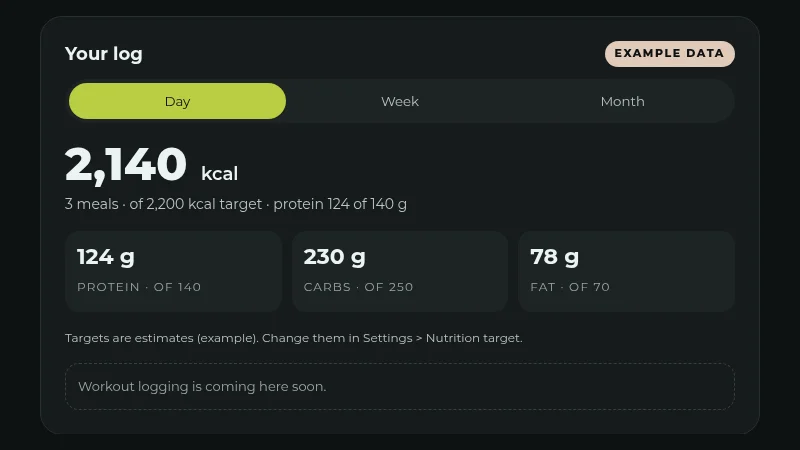
- Keep it in one place. On raphael.fit, the Tracker logs your meals from a photo, your training and your Progress Gallery photos, so food, workouts and visible progress sit side by side.
Common questions
Do I need a wearable?
No. A scale, a tape measure, a phone camera and a simple log already cover weight trend, waist, photos, food and training. Wearables add sleep and HRV estimates, which can be useful if you read them as trends.
Which single number matters most?
It depends on your goal. For fat loss, a weekly average of your weight plus waist size is hard to beat. For performance, track training output and how recovered you feel. For sleep, use total sleep time and a regular wake time.
How often should I weigh myself?
In the trials above, daily weighing was linked to more weight loss and didn't cause psychological harm in adults trying to lose weight. If daily feels stressful, weekly is fine. Consistency matters more than frequency.
The bottom line
A good health dashboard is small, consistent and honest about accuracy. Pick a few numbers that match your goal, measure the same way every time, and look at the trend.
Want to see your own patterns? Log it in the free Tracker.
Open your TrackerThis article is for general information and isn't medical advice. Talk to a qualified health professional about your own situation.
Sources
- Burke et al. 2011, J Am Diet Assoc: self-monitoring in weight loss
- Steinberg et al. 2015, J Acad Nutr Diet: daily weighing and weight loss
- Steinberg et al. 2014, Am J Prev Med: daily self-weighing and psychological outcomes
- Chinoy et al. 2021, Sleep: seven consumer sleep trackers vs polysomnography
- Shaffer & Ginsberg 2017, Front Public Health: HRV metrics and norms
- Front Sports Act Living 2021: accuracy of commercial HR and HRV technologies
- Harvard Health: Heart rate variability
- Texas Heart Institute: HRV and wearable technology
- CDC: Adult BMI categories
- Okorodudu et al. 2010, Int J Obes: diagnostic performance of BMI (meta-analysis)