
 Functional
 Water
 Snap your plate
 Excuse games
 Mind, Body & Beyond
 Store
 Community













































































Food
How much protein do you actually need? A guide by goal
Ask five people how much protein you need and you'll get five answers, from "the RDA is plenty" to "one gram per pound, minimum." The research supports a range, and where you land depends on your goal, your age and how hard you train.
The quick answer
- Minimum for most adults: 0.8 g per kg of body weight a day (about 0.36 g per lb). This is the RDA.
- Active people and athletes: 1.2 to 2.0 g/kg (about 0.55 to 0.9 g/lb).
- Building muscle with lifting: around 1.6 g/kg (about 0.73 g/lb) covers most people. Up to about 2.2 g/kg (1 g/lb) if you want a safety margin.
- Losing fat while lean and lifting: often higher, up to 2.3 to 3.1 g per kg of fat-free mass.
- Adults over 65: about 1.0 to 1.2 g/kg, more if active.
For a 175 lb (80 kg) person, that's about 64 g at the RDA, around 130 g for muscle building, and up to about 175 g at the top of the usual range.
The RDA is a floor, not a target
The RDA of 0.8 g/kg is the amount that meets the needs of almost all healthy adults and prevents deficiency. As Harvard Health Publishing puts it, that's the minimum you need to keep from getting sick, not the amount that's ideal for everyone. Harvard’s Nutrition Source adds that the protein package matters too: beans, fish, poultry and nuts come with a better mix than processed red meat.
What the sports nutrition groups say
The joint position statement from the American College of Sports Medicine, the Academy of Nutrition and Dietetics and Dietitians of Canada recommends 1.2 to 2.0 g/kg a day for athletes, spread across the day and after training.
The International Society of Sports Nutrition (ISSN) position stand lands in a similar place: 1.4 to 2.0 g/kg a day for most exercising people. It notes that higher intakes may help resistance-trained people keep lean mass during a calorie deficit.
Researchers at McMaster University, including Stuart Phillips, ran a large meta-analysis of 49 trials with 1,863 people who lifted while taking extra protein. Protein added modestly to strength and muscle gains, but the benefit leveled off at about 1.6 g/kg a day. Above that, they found no further gains in fat-free mass on average. Because people vary, the authors suggested up to 2.2 g/kg for anyone who wants to cover everyone.
During fat loss
When you eat less, your body is more likely to break down muscle. A systematic review by Eric Helms and colleagues of lean, resistance-trained athletes in a deficit suggested 2.3 to 3.1 g per kg of fat-free mass. Note the "fat-free mass": for someone at 20% body fat, that works out to roughly 1.8 to 2.5 g per kg of total weight. This was based on a small number of studies in lean athletes, so it isn't a rule for everyone.
As you get older
Older muscles respond less to protein. The PROT-AGE study group recommends 1.0 to 1.2 g/kg a day for healthy adults over 65, and at least 1.2 g/kg for those who exercise or are ill, except people with severe kidney disease.
Counterpoints
- More isn't always better. The McMaster meta-analysis found no extra muscle gain on average beyond about 1.6 g/kg. Eating far more mostly adds calories and cost.
- Kidneys. For healthy adults, a meta-analysis found that higher-protein diets didn’t change kidney function differently than normal-protein diets. That doesn't apply to people with kidney disease, who often need to limit protein. The National Kidney Foundation has guidance on that, and anyone with kidney problems should talk to their doctor or a dietitian first.
- Who funds it. Some protein research is supported by the dairy, beef or supplement industries, which the studies above disclose. That doesn't make the results wrong, but independent replication matters.
- Food beats powder. Protein powder is convenient, not required. Hitting your number from whole foods works just as well.
How to put it into practice
- Pick your range. Multiply your weight in kg by your goal number, or your weight in pounds by 0.36 to 1.0.
- Split it up. 3 or 4 meals with roughly 25 to 40 g each is an easy way to get there.
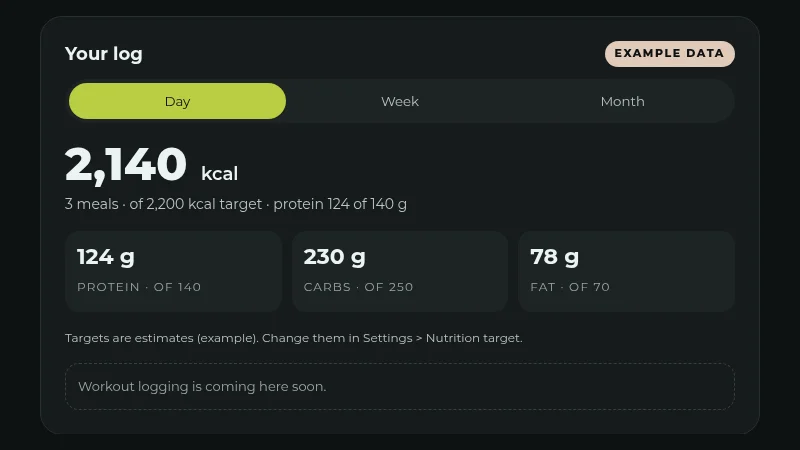
- Check what you actually eat. Most people guess wrong. Snap your meals for a few days in the free food tracker and look at your protein estimate.
- Pair it with training. Protein supports muscle, but lifting is what tells your body to build it. Log your lifts in Lift progress.
The bottom line
The RDA keeps you healthy. If you train, about 1.6 g/kg a day is a strong, evidence-based target, with room to go higher in a deficit or as you age. Consistency matters more than chasing the top of the range.
Want to see your own patterns? Log it in the free Tracker.
Check your protein with a photoThis article is for general information and isn't medical advice. Talk to a qualified health professional about your own situation.
Sources
- Harvard Health Publishing: How much protein do you need every day?
- Harvard T.H. Chan School of Public Health, The Nutrition Source: Protein
- Thomas et al. 2016, Med Sci Sports Exerc: ACSM, Academy of Nutrition and Dietetics and Dietitians of Canada joint position on nutrition and athletic performance
- Jäger et al. 2017, J Int Soc Sports Nutr: ISSN position stand on protein and exercise
- Morton et al. 2018, Br J Sports Med: protein supplementation and resistance training (meta-analysis)
- Helms et al. 2014, Int J Sport Nutr Exerc Metab: protein during caloric restriction in lean resistance-trained athletes
- Phillips & Van Loon 2011, J Sports Sci: dietary protein for athletes
- Bauer et al. 2013, J Am Med Dir Assoc: PROT-AGE recommendations for older people
- Devries et al. 2018, J Nutr: higher-protein diets and kidney function in healthy adults (meta-analysis)
- National Kidney Foundation: Plant-based diet and kidney health