
 Functional
 Water
 Snap your plate
 Excuse games
 Mind, Body & Beyond
 Store
 Community













































































Food
Should you eat most of your protein at breakfast?
Most people eat a light, carb-heavy breakfast and save most of their protein for dinner. There's a growing idea that we should flip that, and eat a big share of our protein in the morning. The evidence is interesting but mixed. Here's what it actually shows.
The case for even meals
At the University of Texas Medical Branch, researchers fed eight healthy adults the same total protein for a week in two ways. One group ate it evenly, about 30 g at each meal. The other skewed it: about 11 g at breakfast, 16 g at lunch and 63 g at dinner. Muscle protein synthesis over 24 hours was 25% higher with the even pattern, and that held after seven days.
A study from RMIT University in Australia gave trained men 80 g of protein over 12 hours after lifting. Four 20 g doses every 3 hours increased muscle protein synthesis more than two big doses or eight small ones.
That's the main logic behind "protein at breakfast": not that morning is magic, but that most people are way under at breakfast, so adding protein there evens out the day.
The case for front-loading
A 2021 study from Waseda University in Japan went further. In mice, protein eaten early in the active phase led to more muscle growth than the same protein later, and the effect depended on the muscle's internal clock. In the human part of the study, people who ate more of their protein at breakfast than at dinner had better muscle mass and grip strength.
Two big caveats: the strongest results were in mice, and the human data were observational, so they show a link, not proof. People who eat a solid breakfast may differ in other ways too.
Appetite and cravings
A University of Missouri trial by Heather Leidy studied 20 young women with overweight or obesity who usually skipped breakfast. Compared with skipping, both breakfasts reduced hunger. Only the high-protein breakfast (35 g protein) also increased fullness, changed appetite hormones, and reduced evening snacking on high-fat foods. Total daily calories didn't differ, though.
So a protein-rich breakfast may help some people feel fuller and snack less at night. It's a small study in one group, so take it as a promising lead, not a guarantee.
Counterpoints
- Longer trials often show no difference. At the University of Arkansas for Medical Sciences, 14 older adults ate either evenly or with 65% of their protein at dinner for 8 weeks. There were no differences in lean mass, strength or function. Small study, but it's one of the few that ran for weeks.
- Total protein matters most. Reviews generally agree that hitting your daily total is the big lever. Distribution is fine-tuning on top. See How much protein do you actually need?
- The "30 g limit" is a myth. Researchers at Maastricht University showed that 100 g of protein after exercise produced a bigger and longer muscle-building response than 25 g. Your body doesn't waste everything above 30 g, so a big dinner isn't wasted either.
- Industry ties. Some of these researchers disclose funding or fees from beef, dairy or supplement groups. That's common in this field and worth knowing.
What most experts suggest
Brad Schoenfeld (CUNY Lehman College) and Alan Aragon (Cal State Northridge) reviewed the per-meal evidence. They suggest about 0.4 g/kg per meal across at least four meals, to reach at least 1.6 g/kg a day. For an 80 kg (175 lb) person, that's about 32 g per meal. The ISSN position stand also recommends spreading protein every 3 to 4 hours across the day.
How to put it into practice
- Get your daily total first. That's the part with the strongest evidence.
- Bring breakfast up to 25 to 40 g. Eggs, Greek yogurt, cottage cheese, tofu, a protein shake, or leftovers from dinner all work.
- Don't force it. If you train fasted or just aren't hungry in the morning, a higher-protein lunch and dinner can still get you there.
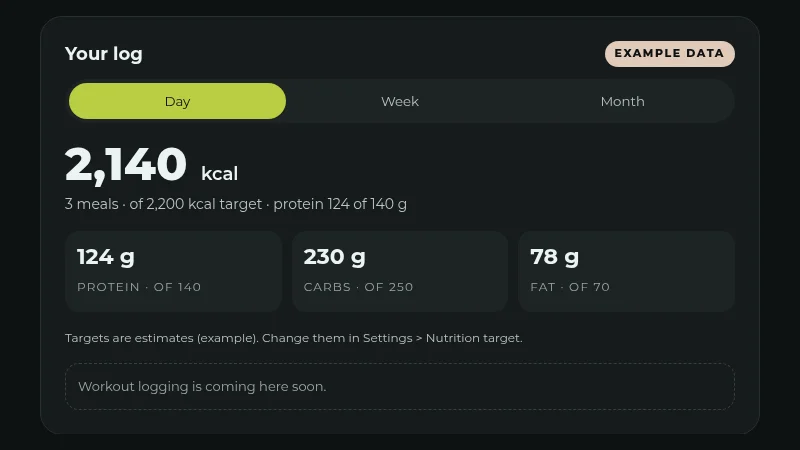
- See your pattern. Snap each meal for a few days in the free food tracker. If breakfast shows 10 g and dinner shows 60, you know where to start.
The bottom line
Eating all or most of your protein at breakfast isn't proven to be better. Eating a solid amount of protein at breakfast, instead of almost none, is a reasonable, low-risk change that may help with fullness and spreads your intake out. Hit your total first, then fix breakfast.
Want to see your own patterns? Log it in the free Tracker.
Snap your breakfast and check the proteinThis article is for general information and isn't medical advice. Talk to a qualified health professional about your own situation.
Sources
- Mamerow et al. 2014, J Nutr: protein distribution and 24-h muscle protein synthesis
- Areta et al. 2013, J Physiol: timing and distribution of protein after resistance exercise
- Aoyama et al. 2021, Cell Reports: protein at breakfast, muscle clock and hypertrophy
- Leidy et al. 2013, Am J Clin Nutr: higher-protein breakfast, appetite and evening snacking
- Kim et al. 2018, Clin Nutr: protein distribution pattern over 8 weeks in older adults (RCT)
- Trommelen et al. 2023, Cell Rep Med: no upper limit to the anabolic response to protein
- Schoenfeld & Aragon 2018, J Int Soc Sports Nutr: how much protein can the body use in a single meal?
- Jäger et al. 2017, J Int Soc Sports Nutr: ISSN position stand on protein and exercise